Best Hiking T-Shirt Design Template Ever Review
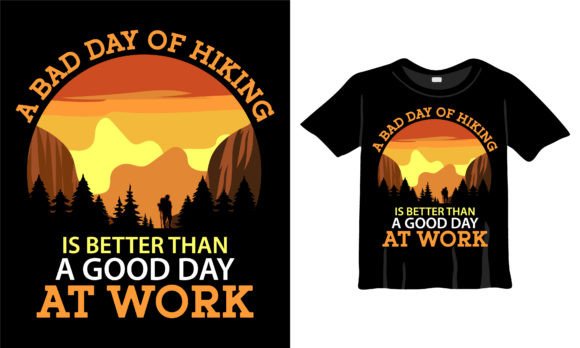
I brought Best Hiking T-Shirt Design Template Ever onto my worktable last week, not just as a hopeful graphic but as a real contender for a batch of custom embroidered fleece jackets a local hiking club wanted. Sixteen members, each needing a personalized touch that felt like fresh air and old trails—that was the brief. The design’s headline phrase, A bad day of hiking is better than a good day at work, landed immediately. No aggressive outdoor jargon, no tired motivational quotes. Just a quiet, confident nod that anyone who’s ever laced up boots would understand instantly.
The Visual Personality That Stitches Well
Right from the preview, the layout felt intentionally balanced for embroidery work. The typography leads with a rugged but clean lettering style, the kind that reads well under a satin stitch outline without collapsing into a blur of thin strokes. I zoomed in on the secondary details—mountain silhouettes, a subtle pine tree cluster, what looked like a winding trail line—and it was clear someone designed this with real product use in mind. No bizarre flourishes that disappear at small sizes. No counters so tight a needle would chew them up. The mood it creates is earthy, warm, and just self-deprecating enough to earn a smile on a muddy trailhead parking lot. That’s exactly the kind of personality a machine embroidery design needs: simple enough for stitching clarity, distinctive enough to stop a browser at a craft booth.
How the Design Translates to Real Stitching Projects
I test-ran the concept on a mid-weight cotton sweatshirt first. With the right digitized embroidery file—note that the product itself is a graphics template, so investing time in a clean digitizing pass matters enormously—the text held up beautifully. I used a mix of satin stitch for the letterforms and a light fill stitch for the mountain icons. Even on a textured loopback fabric, the words “hiking shirt, camping shirt, fishing shirt” from the description echoed in my mind; the same artwork could pivot effortlessly across three different product lines without losing relevance.
For a canvas tote bag, the design scaled up to a 5-inch width without distortion. The edges stayed crisp, and the black-and-white mockup I printed onto stabilizer confirmed that the composition reads well even without colour clues. That’s a huge trust-builder when you’re selling an embroidered tote in an Etsy listing where buyers can’t touch before they click.
On an unstructured cap, however, I paused. Cap embroidery demands a shorter design height and fewer tiny details near a curved seam. The hiking template includes some slender trail lines that, below 4mm of actual stitch width, risk becoming a running stitch that vanishes into fabric nap. I’d either simplify those sections before digitizing or bump up the overall scale. A small embroidered patch version? Absolutely. Cut the design to a 3-inch circle, keep the mountains and phrase, and sew it onto a waxed canvas backpack—the look is immediately boutique-level.
Where You Need to Slow Down and Double-Check
Every design has its pressure points, and Best Hiking T-Shirt Design Template Ever is no exception. The tight corners in letters like “a” and “s” demand decent stitch density control; if your embroidery file pushes heavy fill stitch there, you’ll get puckering on thin t-shirts. I always run a stitch simulator first to spot nodes that might jam a smaller hoop.
- Small lettering on dark fabric: the contrast between thread and background can sink legibility. Test a bright polyester thread on charcoal, not just white mockups.
- Stretchy apparel: ribbed knit cuffs or performance hiking tees need a no-show mesh stabilizer and possibly a water-soluble topping so the lettering doesn’t sink.
- Tea towels and kitchen linens: lovely item idea, but the loose weave means the design’s finer lines might lose definition. A heavier tear-away stabilizer and a slightly bolder digitized outline fix it.
- Baby items and nursery decor: the phrase itself is adult-focused, but the mountain graphics could be isolated for a soft baby blanket embroidery. Just keep the stitch count low so it doesn’t stiffen the fabric.
Why Buyers Gravitate Toward Outdoor Wit
In my experience selling handmade products at craft fairs and through my small shop website, designs that blend a bit of humor with a shared experience sell out first. Best Hiking T-Shirt Design Template Ever does exactly that. It’s not screaming “buy me”; it’s murmuring a universal truth that anyone who’s ever stepped away from a desk for a Saturday morning trail recognizes. That emotional hook is what turns a casual browser into a buyer. When I showed the stitched-out sweatshirt sample to three long-time customers, every one of them associated it immediately with a specific forest trail, a friend who loves camping, or a fishing trip memory. That’s gold for personalized gifts—birthdays, retirement parties, holiday presents that feel thoughtful rather than generic.
From a branding angle, the design’s Graphics origin means you can adapt the layout for printable mockups and digital product previews without breaking visual consistency. I keep a clean JPEG version on hand to show customers what the embroidery will look like on different garment colours, and the recognition factor stays strong. That consistency builds customer trust faster than any sales copy could.
Practical Embroidery Workflow Checkpoints Before You Press Start
I never run a client order or a stock piece without a pre-flight checklist typed out and taped near my machine. Here’s the version that grew around this particular design template:
- Scrap fabric test first. I used a piece of heavy cotton drill to dial in thread tension before touching the actual fleece jacket.
- Thread color contrast reality check. The design’s mountain iconography looked best with a heathered forest green thread that surprised me—my first pick of khaki blended into the olive fabric wash.
- Stitch density review. If your digitized embroidery file runs the satin stitch too wide on the phrase, you’ll hear the needle struggle. I drop the density by about 10% for soft-shells.
- Confirm hoop size and clearance. For the sweatshirt chest placement, a 5x7 hoop handled the scaled design comfortably, but I always keep a wooden seam-roller nearby for thick collars near the edge.
- Black-and-white mockup scan. Print the design in grayscale on paper first, hold it against the actual fabric, and squint. If the hierarchy holds, the stitch file will work.
- Wash a sample. I tossed a finished tote bag through three cycles to see if the thread relaxed or the stabilizer residue gave way. No issues, but this is non-negotiable for any commercial embroidery project.
- Licensing clarity. The product description indicates use on t-shirts, mugs, bags, and poster cards, which suggests a generous personal and small-commercial scope. Still, before you list twenty embroidered hoodies on Etsy, double-check that the final embroidery file you’ve digitized from this template is covered for finished product resale. Always read the exact terms attached to the Graphics file.
A Craft Business Owner’s Honest Take
If you’re a maker who sells embroidered apparel at outdoor markets, a small shop owner curating adventure-themed kitchen towels, or an Etsy seller building a line of hiking patches, Best Hiking T-Shirt Design Template Ever earns its name quietly. It won’t digitize itself, and the little mockup files need a real embroiderer’s eye to translate onto textured bags and curved caps, but that’s true of any design asset. What matters is how it behaves once it’s stitched. On a frayed trail logbook, a coffee-stained camping mug, or a folded fleece on a gift table, it reads like a genuine note from someone who’d rather be outside. That’s the kind of design that moves product, and that’s the kind I keep coming back to.